







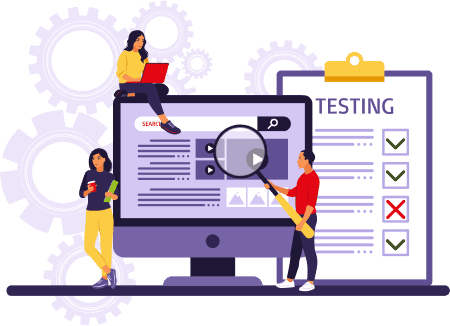
Discovery & Strategy
- Understanding the business
- Identifying project requirements
- Drafting proposal document & milestone breakup




Data science consulting helps businesses turn their data into predictions and decisions, using statistics, machine learning, and AI to forecast demand, reduce churn, detect fraud, and price better. Techno Exponent is a data science consulting company that helps start-ups, scale-ups, and enterprises solve business problems with predictive modeling, machine learning, and applied AI. We validate feasibility and ROI first, then build, deploy, and monitor production-ready models on your data using MLOps best practices.
Techno Exponent is a software and AI company headquartered in Kolkata, India, with teams around the globe. The company delivers Data Science solutions for businesses to drive decision-making, growth, and business.

4.9/5 ★★★★★Clutch Review

4.1 ★★★★★Google Review


80% of Business Comes
from existing clients
Our team consists of
Gold Medallists, patent holders,
and PhD holders
Techno Exponent delivers end-to-end data science solutions, from use-case discovery, data strategy, and statistical modeling to predictive ML, AI (NLP, computer vision, generative AI), MLOps deployment, and decision-ready dashboards.

Our primary goal is to uncover data science use-cases for your business. We look for business questions that can be turned into data science problems with defined success metrics. We evaluate models, ROI, and feasibility before development begins.

We assess your data maturity (from ad-hoc reporting to AI-driven decisions), identify gaps in data quality, tools and skills, and build a 6–12 month data strategy roadmap.

Exploratory data analysis (EDA) uncovers patterns, correlations, outliers, and data limitations that determine which data modeling approaches will work. Our team applies hypothesis testing, customer and product segmentation, and A/B test design to produce evidence-backed insights.

Predictive modeling uses historical data to forecast outcomes such as churn, demand, fraud, or lead conversion. We build and benchmark classification, regression, time-series forecasting, and clustering models, with feature engineering and cross-validation to ensure results hold up on unseen data. Models are evaluated against business-relevant metrics, including precision, recall, AUC (Area Under the Curve), and RMSE (Root Mean Squared Error).

Applied AI extends data science to unstructured data such as text, images, and documents. Our capabilities include natural language processing (sentiment analysis, document classification), computer vision (defect detection, image recognition), recommendation engines, and generative AI applications such as retrieval-augmented generation (RAG), fine-tuned LLMs, and enterprise copilots.
MLOps is the practice of deploying, monitoring, and maintaining ML models. We package models as APIs or batch pipelines, set up CI/CD for model releases, and implement monitoring for data drift and performance decay, along with automated retraining workflows to keep predictions accurate over time.
Decision reporting turns model outputs into dashboards and narratives that non-technical stakeholders can act on. We build interactive BI dashboards and executive summaries so insights reach the people making decisions.
Data science project costs are driven mainly by how messy the data is and how complex the problem is, then amplified by data scale, engineering and infrastructure needs, team seniority, accuracy and compliance requirements.
At Techno Exponent, a data science proof of concept costs USD 1,000–5,000 and takes 1-4 weeks. A production MVP costs USD 3,000–10,000 over 1–2 months. Enterprise solutions with multiple integrations and compliance reviews start at USD 10,000+. Team rates start at USD 15–25 per hour.
| Item | Typical Range (USD) | Timeline |
|---|---|---|
|
Discovery & use-case consulting
|
$
15-25 Per Hour
|
Minimum 8 hours
|
|
Data assessment & readiness audit
|
$
15-25 Per Hour
|
Minimum 8 hours
|
|
Data engineering & pipelines
|
$
15-25 Per Hour
|
Minimum 8 hours
|
|
Exploratory analysis & feature engineering
|
$
15-25 Per Hour
|
Minimum 8 hours
|
|
Model development & training
|
$
15-25 Per Hour
|
Minimum 8 hours
|
|
Validation & evaluation
|
$
15-25 Per Hour
|
Minimum 8 hours
|
|
API & system integrations
|
$
15-25 Per Hour
|
Minimum 8 hours
|
|
Dashboards & decision
|
$
15-25 Per Hour
|
Minimum 8 hours
|
|
Security, compliance & governance
|
$
15-25 Per Hour
|
Minimum 8 hours
|
|
Deployment & MLOps
|
$
15-25 Per Hour
|
Minimum 8 hours
|
Hire data scientists through our flexible engagement models customized for your project, budget, and business goals


Techno Exponent has provided GenAI solutions for the Boston Children’s Hospital, BellAgent, and QuickFMS.

We apply data science to detect fraud, score credit risk, and predict customer churn.

We help healthcare organizations stratify patient risk, forecast appointments and demand, and classify clinical documents.

We build demand forecasting, recommendation, dynamic pricing, and customer segmentation models that drive sales and retention.

We optimize routes, predict delivery times, and forecast fleet and inventory needs to improve operational efficiency.

We develop property valuation models, lead scoring systems, and market trend analyses to support smarter investment and sales decisions.

We predict student performance, detect dropout risk early, and deliver personalized learning recommendations.

We power content recommendations, audience analytics, and sentiment analysis to boost engagement.

We forecast occupancy and revenue, analyze guest review sentiment, and personalize the guest experience.

We forecast service demand, automate document processing, and analyze policy impact to support evidence-based decisions.
We check models for bias, document their limits and keep humans in the loop for high-impact decisions.



Python
R
TypeScript
SQL
C/C++
Java
Julia
Scala
JavaScript
Swift
Go
MATLAB
SAS
TensorFlow
Scikit-learn
Keras
Pandas
Spark
MLib
PyTorch
Matplotlib
NumPy
Seaborn
Theano
TensorFlow
NumPy
SciPy
Pandas
Matplotlib
Keras
Scikit-learn
PyTorch
Scrapy
BeautifulSoup
SQLAlchemy
Flask-RESTful
XGBoost
OpenCV
MongoDB
PostgreSQL
Google Cloud
MySQL
Sybase
SQLite
Company Databases
JSON
Oracle9i
Oracle RDBMS
SQL Server
Apache Hive
NoSQL
AWS S3
SAS
Apache Spark
BigML
D3.js
MATLAB
Excel
Tableau
ggplot2
Jupyter
Matplotlib
NLTK
Scikit-learn
TensorFlow
Weka
Google Cloud Platform (GCP)
Docker
Jupyter Notebook
Amazon Web Services (AWS)
Alteryx
RStudio
DataRobot
Anaconda
Lambda
AWS EC2
H2O
RapidMiner
TIBCO
Domino




Meet the experts driving innovation and delivering results.

CEO & Chief AI Scientist


Chief Operating Officer (COO)

Chief Business Officer (CBO), Director (HR Department)

Global CTO


Many organizations collect massive amounts of data but lack the specialized expertise to extract its true value. Our data science consulting services provide the bridge between having raw information and actually using it to drive growth. By evaluating your data maturity, our consultants help you stop making decisions based on gut feeling and start using historical patterns to forecast market trends and identify high-impact AI opportunities.
Beyond just finding insights, our consultants ensure your data infrastructure is built for long-term scalability. They help you navigate the noise to focus on projects that matter, like automating repetitive tasks, reducing operational waste, and preparing your datasets for AI adoption. This strategic approach prevents you from wasting resources on complex models that don't solve real problems, ensuring every data initiative delivers a measurable return on investment.
Data science focuses on building models to predict future outcomes, while data analytics focuses on examining existing data to understand performance and support business decisions. Data analytics explains what happened and why, whereas data science can help predict what may happen next and recommend possible actions. Both use statistical methods, data processing, and visualisation to generate business insights.
Data science is a broad field that uses statistics, programming, and data analysis to solve business problems, while machine learning is a subset of data science that enables systems to learn patterns from data and make predictions. Data science covers the entire process, from data collection and preparation to analysis and reporting. Machine learning focuses on training and evaluating models that improve their performance through data.
Data science consulting services help businesses use data, statistical analysis, and predictive models to solve problems and improve decision-making. These services typically include data strategy, data preparation, exploratory data analysis, predictive modelling, machine learning, demand forecasting, and AI readiness assessments. Consultants also help businesses identify high-value use cases, implement scalable data solutions, and measure business outcomes.
A data science consultant is a specialist who helps businesses turn raw data into actionable insights, predictive models, and practical business solutions. Their responsibilities typically include assessing data quality, identifying business opportunities, analysing datasets, developing statistical and machine learning models, and communicating findings to stakeholders. They may also support model deployment, performance monitoring, and data strategy to ensure solutions deliver measurable business value.
AI is unlikely to replace data science or data scientists entirely, but it is changing how data science work is performed. AI tools can automate repetitive tasks such as data cleaning, code generation, basic analysis, and report creation. However, human expertise remains essential for defining business problems, validating results, addressing data bias, interpreting complex findings, and making strategic decisions. Data scientists who combine domain knowledge, statistical skills, and AI expertise can use these tools to work more efficiently.
Demand forecasting is the process of estimating future demand for a product or service using historical data, market trends, and other relevant factors. Businesses use it to manage inventory, plan production, allocate resources, and reduce operational costs.
The main demand forecasting methods include:
Time series analysis: Uses historical demand patterns, trends, and seasonality to predict future demand.
Regression analysis: Examines how factors such as price, promotions, and economic conditions influence demand.
Qualitative forecasting: Uses expert opinions, customer surveys, and market research when historical data is limited.
Machine learning forecasting: Uses algorithms to identify complex patterns across large datasets and generate predictions.
Causal forecasting: Estimates demand based on relationships between demand and influencing factors, such as advertising expenditure or market conditions.
Businesses often combine multiple forecasting methods to improve accuracy and adapt to changing market conditions.
Demand forecasting is the process of predicting how much of a product or service customers will want in the future. It uses past sales data, seasonal patterns, market trends, and outside factors like holidays, weather, or promotions.
Businesses use these predictions to plan ahead. A good forecast helps you:
Manage inventory: Avoid running out of stock or overstocking.
Plan production: Make the right quantity at the right time.
Control costs: Reduce waste and storage expenses.
Schedule staff: Match workforce size to expected demand.
Set budgets and prices: Make financial decisions based on expected sales.
Predictive analytics uses past and current data to forecast what is likely to happen next. It finds patterns in historical data and applies them to new situations to estimate future outcomes.
Businesses use it to:
Forecast sales and demand: Plan stock and production.
Predict customer churn: Spot customers likely to leave.
Detect fraud: Flag unusual transactions early.
Assess risk: Score credit, insurance, or loan applications.
Plan maintenance: Fix equipment before it breaks.
Target marketing: Reach customers most likely to buy.
It does not guarantee outcomes. It gives probabilities, which help people make better decisions.
Predictive analytics is neither one exactly, but it often uses both. It is a goal: predicting future outcomes. AI and ML are methods that can help reach that goal.
Statistics: Many predictive models use traditional methods such as regression and time-series analysis. These are not necessarily ML or AI.
Machine learning: Modern predictive analytics often uses ML models such as decision trees and neural networks. They learn patterns from data to generate predictions.
AI: Since ML is a part of AI, ML-based predictive analytics can also be considered an AI application.
In short, predictive analytics is the task, and ML is a common tool for doing it.


Copyright © 2026, TECHNO EXPONENT, All Rights Reserved.
Techno Exponent is the brand name of T-WEB EXPONENT SERVICES PRIVATE LIMITED (CIN U72300WB2016PTC210128), founded 2011, Kolkata, India.