 (+44) 7893 942215
 (+1) 918 238 5761
 (+61) 468 288 314
 (+91) 9831584855 (Sales only)






Data analytics finds uses in several industries like healthcare, finance, and e-commerce. At Techno Exponent, we would like to share some of the data analytics use cases that we have worked on and some of the common use cases that are popular in the industry.
These use cases are something that we offer to our customers from clinics, hospitals, e-commerce stores, and financial services.
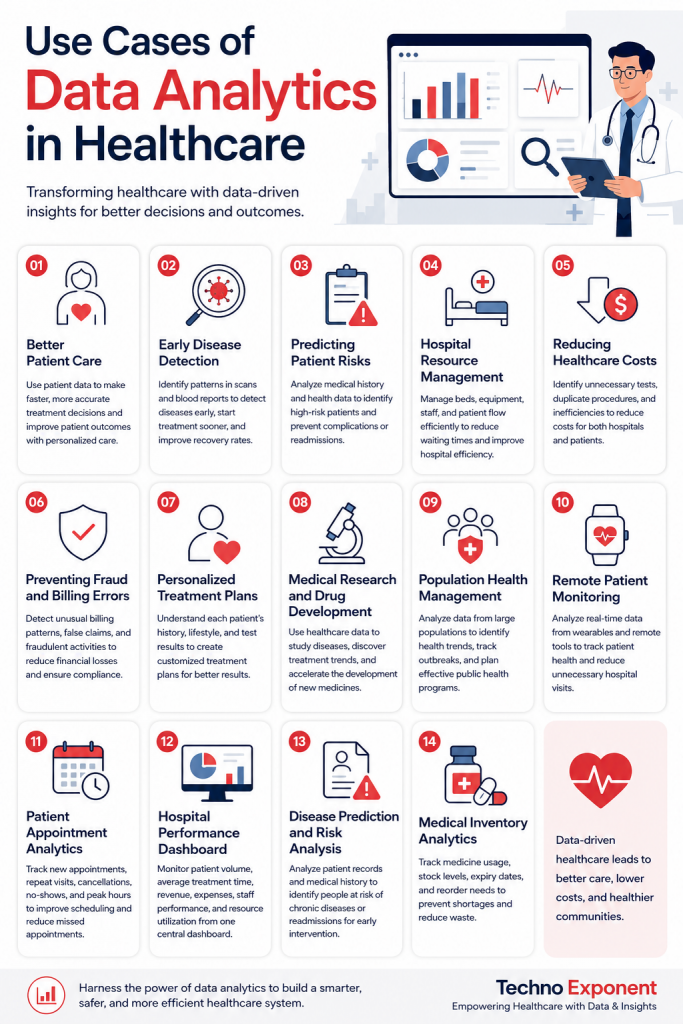
Use Cases of Data Analytics in Healthcare
- Better Patient Care
Doctors and hospitals can use patient data (treatment history, blood reports, etc) to make faster and more accurate treatment decisions. This helps improve patient outcomes and provide more personalized care.
- Early Disease Detection
Data analytics can identify patterns in reports like scans and blood reports that may point to diseases before symptoms become severe. This allows doctors to start treatment earlier and improve recovery rates.
- Predicting Patient Risks
Just by analyzing medical history and current health data, doctors can identify patients who are at a higher risk of complications or hospital readmissions and notify them of the same easily.
- Hospital Resource Management
Hospitals use analytics to manage the availability of beds, medical equipment, staff schedules, and patient flow. This reduces waiting times and improves overall efficiency. We can create such a dashboard for you at Techno Exponent.
- Reducing Healthcare Costs
Data analytics helps patients identify unnecessary tests, duplicate procedures, and inefficient processes. As a result, hospitals can help lower costs for patients.
- Preventing Fraud and Billing Errors
Hospitals use data analytics to detect unusual billing patterns, false insurance claims, and fraudulent activities. This helps them reduce financial losses and improve compliance.
- Personalized Treatment Plans
Data analytics helps doctors understand a patient’s medical history, lifestyle, and test results to create treatment plans that are customised to their needs.
- Medical Research and Drug Development
Researchers use healthcare data to study diseases, discover treatment trends, and speed up the development of new medicines and therapies.
- Population Health Management
National and state healthcare providers can analyze data from large groups of people to identify health trends, track disease outbreaks, and plan public health programs.
- Remote Patient Monitoring
Data from wearable devices and remote monitoring tools can be analyzed in real time. This helps doctors track patients with chronic conditions, detect their health issues early, and reduce unnecessary hospital visits.
- Patient Appointment Analytics
Patient appointment analytics helps professionals track new appointments, repeat visits, cancellations, no-shows, and peak consultation hours. This helps healthcare providers improve scheduling and reduce missed appointments.
- Hospital Performance Dashboard
A hospital performance dashboard helps to monitor patient volume, average treatment time, revenue, expenses, staff performance, and resource utilization from a single dashboard. This gives hospital administrators a complete view of operations.
- Disease Prediction and Risk Analysis
A disease prediction and risk analysis dashboard analyzes patient records and medical history to identify people at risk of chronic diseases or hospital readmissions. This enables early treatment and preventive care.
- Medical Inventory Analytics
Clinics and pharmacies can track medicine usage, stock levels, expiry dates, and reorder requirements. This helps hospitals avoid medicine shortages and reduce waste.
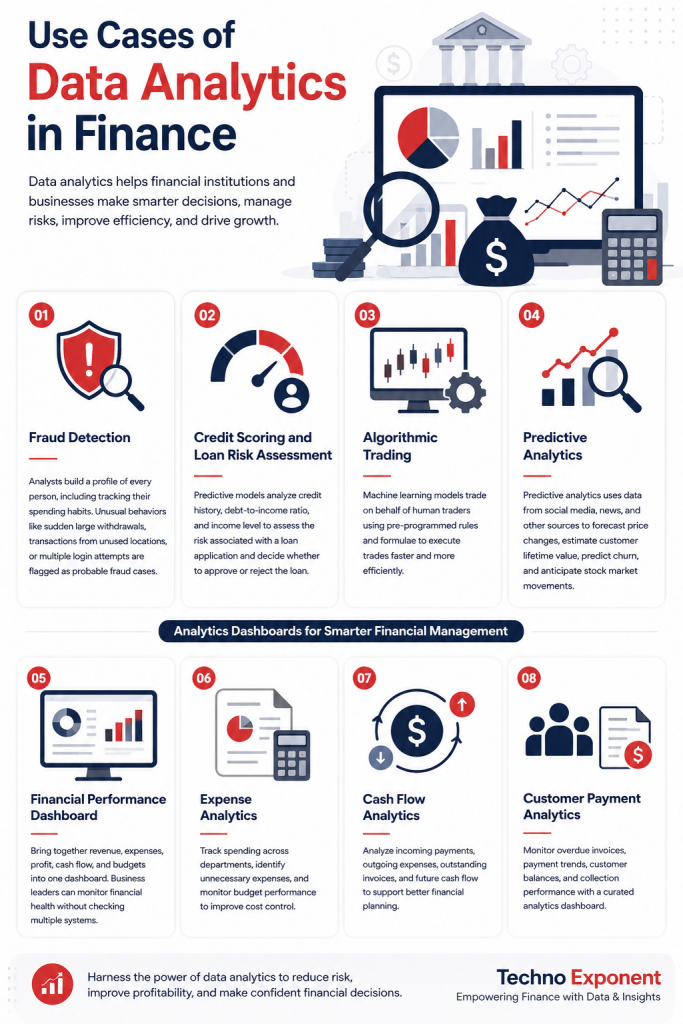
Use Cases of Data Analytics in Finance
- Fraud Detection
Analysts spend time building a profile of every person, including tracking their spending habits. When they observe certain behaviors that are very different from the normal spending habits of a person, they flag that as a probable case of fraud. If there is a sudden large amount of cash withdrawal or transactions from unused locations or multiple login attempts, then the bank itself will flag these events as probable cases of fraud.
- Credit Scoring and Loan Risk Assessment
Predictive analytical models are often used to calculate the risk associated with a person seeking a bank loan. The model analyses the credit history, debt-to-income ratio, and the income level of the person before deciding whether to sanction a loan to them or not.
- Algorithmic Trading
Using machine learning models to trade on behalf of human traders is referred to as algorithmic trading. Algorithmic trading involves executing trading instructions with pre-programmed rules and formulae.
- Predictive Analytics
Predictive analytics uses patterns in data to predict what will happen in the future. By analyzing data from social media, news, and other sources, advanced analytics can forecast price changes, estimate customer lifetime value, predict major life events, identify potential customer churn, and anticipate movements in the stock market.
- Financial Performance Dashboard
Bring together revenue, expenses, profit, cash flow, and budgets into one dashboard. Business leaders can monitor financial health without checking multiple systems.
- Expense Analytics
We can build you a dashboard to track spending across departments, identify unnecessary expenses, and monitor budget performance to improve cost control.
- Cash Flow Analytics
Our team can build a dashboard to help yours analyze incoming payments, outgoing expenses, outstanding invoices, and future cash flow to support better financial planning.
- Customer Payment Analytics
Monitor overdue invoices, payment trends, customer balances, and collection performance with our curated analytics dashboard.
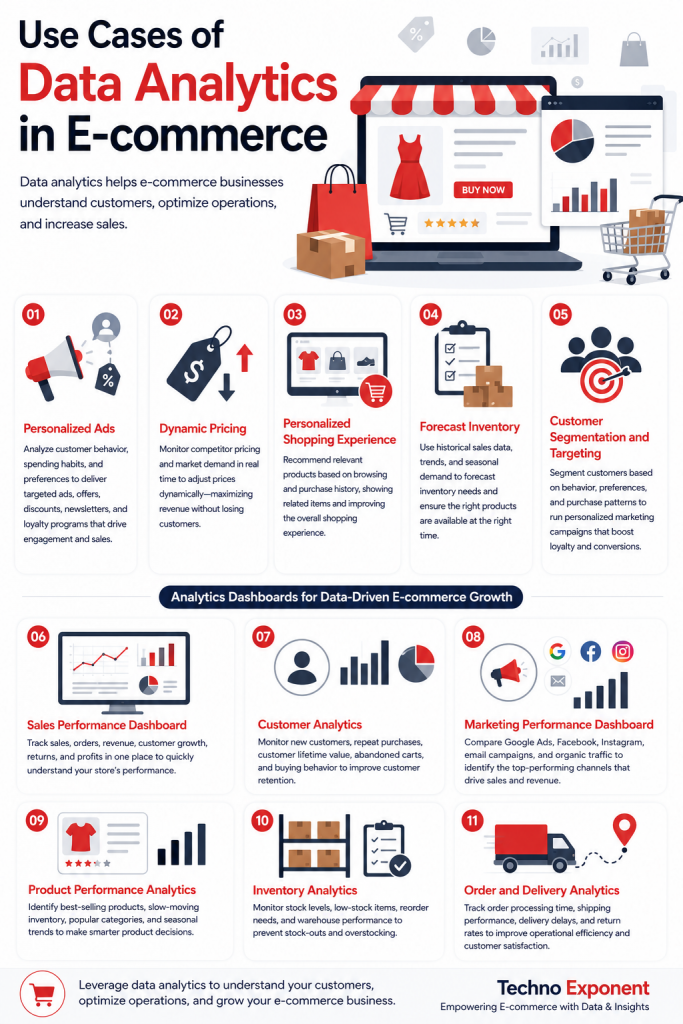
Use Cases of Data Analytics in E-commerce
- Personalized Ads
Retailers can use data analytics to show personalised ads to customers. The spending habits of customers are studied, including how they spend, when they spend, and whom and what they spend on. These insights are meticulously analysed, and then customers are targeted with ads, offers, discounts, newsletters, loyalty programs, etc.
- Dynamic Pricing
If competitors are lowering or hiking prices, retailers need to be aware of how their prices fit in the grand scheme of things. Too low, and they stand to make a loss; too high, and no one buys their product. It’s all about maintaining that perfect dynamic pricing when demand surges and when demand falls.
- Personalized Shopping Experience
Almost all shopping websites nowadays offer a personalized shopping experience. This means that if you shop for a product, say bread, related products like sandwich spreads, jams, and butters will be automatically shown to you. Retailers like Amazon, Flipkart, and others analyse a customer’s purchase and make product recommendations accordingly.
- Forecast Inventory
Just by analysing past data and sales trends and seasonal demands, companies can forecast their inventory to maintain the requisite goods on the shelves.
- Customer Segmentation and Targeting
You may have seen the Customers Like You Also Viewed section on major shopping portals like Shein and Myntra. Analytics helps businesses segment customers based on their behavior, preferences, and purchasing patterns. These insights enable personalized recommendations and targeted marketing campaigns that resonate with individual interests, increasing customer engagement and loyalty.
- Sales Performance Dashboard
With a sales performance dashboard, retailers can view sales, orders, revenue, customer growth, returns, and profits in one place. Business owners can quickly understand how their online store is performing.
- Customer Analytics
With a customer analytics dashboard, you can track new customers, repeat purchases, customer lifetime value, abandoned carts, and buying behavior. This helps businesses improve customer retention.
- Marketing Performance Dashboard
Compare Google Ads, Facebook, Instagram, email campaigns, and organic traffic to see which channels generate the most sales and revenue on your custom-built marketing performance dashboards.
- Product Performance Analytics
Identify best-selling products, slow-moving inventory, popular categories, and seasonal trends. This helps businesses make smarter inventory decisions with a product performance analysis.
- Inventory Analytics
An inventory analytics dashboard helps you monitor stock levels, low-stock products, reorder requirements, and warehouse performance to prevent stock-outs and overstocking.
- Order and Delivery Analytics
Track order processing time, shipping performance, delivery delays, and return rates to improve customer satisfaction.
Frequently Asked Questions
Will healthcare data analysts be replaced by AI?
No. AI can automate routine tasks and process large datasets quickly, but healthcare data analysts are still needed to interpret results, ensure data accuracy, and make informed decisions based on clinical and business context.
Can a data analyst work in healthcare?
Yes. Data analysts play an important role in healthcare by analyzing patient, operational, and financial data to improve patient outcomes, reduce costs, and support better decision-making.
What are the four types of data analytics in healthcare?
The four main types are:
- Descriptive Analytics – Understands what happened.
- Diagnostic Analytics – Explains why it happened.
- Predictive Analytics – Forecasts future outcomes.
- Prescriptive Analytics – Recommends the best course of action.
How to become a data analyst in healthcare?
To become a healthcare data analyst, earn a degree in data analytics, healthcare, or a related field, develop skills in SQL, Excel, Python, and data visualization tools, and gain experience working with healthcare data and regulations.
How is data analytics used in eCommerce?
eCommerce businesses use data analytics to track customer behavior, optimize pricing, personalize recommendations, manage inventory, and improve marketing campaigns, leading to better customer experiences and higher sales.
What does an eCommerce data analyst do?
An eCommerce data analyst collects and analyzes sales, customer, and website data to identify trends, measure business performance, and provide insights that improve conversions, customer retention, and revenue.
What is the 80/20 rule in eCommerce?
The 80/20 rule, or Pareto Principle, suggests that around 80% of sales or revenue often comes from 20% of customers or products. Businesses use this insight to focus on their most valuable customers and best-performing products.
What are the 4 types of data analysis?
The four types of data analysis are descriptive, diagnostic, predictive, and prescriptive. Together, they help businesses understand past performance, identify causes, predict future trends, and make data-driven decisions.
What is data analytics in healthcare?
Healthcare data analytics is the process of collecting and analyzing medical data to improve patient care and hospital operations. It helps healthcare providers make better decisions, reduce costs, and deliver more personalized treatment.
What are the most important use cases of data analytics in healthcare?
Data analytics is used in many areas of healthcare, including predicting disease outbreaks, improving patient care, reducing hospital readmissions, managing staff and resources, detecting fraud, and speeding up medical research.
How is predictive analytics used in healthcare?
Predictive analytics uses historical and real-time data to forecast future health outcomes. It can help identify patients at risk of developing certain conditions, predict hospital admissions, reduce readmissions, and support early medical intervention.
What are the benefits of data analytics in healthcare organizations?
Data analytics helps healthcare organizations improve patient outcomes, lower operational costs, optimize hospital resources, reduce medical errors, and make faster, data-driven decisions. It also helps deliver a better experience for both patients and healthcare staff.
How is data analytics transforming the healthcare industry?
Data analytics is making healthcare smarter by turning large amounts of medical data into useful insights. It helps doctors diagnose diseases faster, supports personalized treatment plans, improves hospital efficiency, and enables preventive care instead of reactive treatment.
What role does AI play in healthcare data analytics?
AI makes healthcare data analytics faster and more accurate. It can analyze large volumes of medical data, identify patterns, predict health risks, assist in diagnosing diseases, and automate routine tasks, allowing healthcare professionals to focus more on patient care.
