 (+44) 7893 942215
 (+1) 918 238 5761
 (+61) 468 288 314
 (+91) 9831584855 (Sales only)






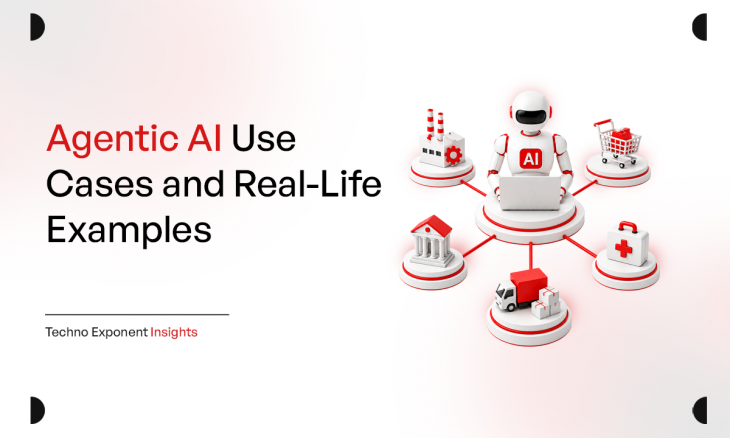
When investing in agentic AI, it pays to know which types of agentic AI are already out there, which companies are working with agentic AI, and what the top agentic AI use cases are.
This blog is a compilation of all the agentic AI use cases available in the industry as of today and serves as a resource for business owners who want to implement AI use cases into their workflows.
Take a look at the ways in which agentic AI has been used so far in the industry. Dive right in!
What is Agentic AI? How Does Agentic AI Work?
Agentic AI is a type of artificial intelligence that can understand goals, make decisions, and complete tasks with minimal human intervention. Unlike traditional AI, which only responds to prompts, agentic AI can plan, take actions, learn from feedback, and use different tools to solve complex problems on its own.
Agentic AI works by combining a large language model (LLM), memory, reasoning, and external tools. It first understands the user’s goal, creates a plan, gathers information from connected systems, performs the required actions, and evaluates the results. If needed, it adjusts its approach and continues until the task is complete, enabling it to handle complex, multi-step workflows autonomously.
You May Also Like: The Guide to Agentic AI Solutions for Businesses
What Are Some Agentic AI Use Cases and Real-Life Examples?
- Agentic AI use cases in banking
AI agents are transforming banking by providing personalized financial advice, supporting bankers with instant access to knowledge, automating loan underwriting and expense reporting, continuously monitoring compliance, and detecting fraud and unusual spending patterns to improve efficiency, accuracy, and customer experience.
| Type of Function | What it Means | Institution / Agent Name |
| Advisory | Provides bankers and customers with advice on what moves to make concerning investments. Coach AI helps financial advisors provide suggestions, especially during market volatility. | JPMorgan Chase (Coach AI) |
| Customer Service | Provides customers with details of transactions, spending insights, fraud alerts, and personalized financial guidance. | Bank of America (Erica AI), Wells Fargo |
| Research and knowledge banks | Helps financial advisors instantly search thousands of research documents, meeting notes, and internal knowledge sources, reducing research time and improving client service. | Morgan Stanley, Citi |
| Fraud Detection | Studies vast amounts of customer data, including spending habits, which helps to create a spending profile. If there are strange or unauthorised transactions, the system immediately flags them. It detects unusual activity in customers’ accounts, helping to quash emerging threats. | HSBC, MasterCard, Visa, American Express |
| Loan Underwriting | An AI agent reviews borrower documents, verifies financial information, assesses credit risk, checks compliance, and prepares an underwriting recommendation—reducing approval times from days to hours while allowing human underwriters to focus on complex cases. | JPMorgan Chase, Upstart, Fannie Mae, MNT-Halan |
| Anti-Money Laundering Compliance | AI analyzes millions of transactions to identify suspicious patterns that may indicate money laundering or other financial crimes, helping investigators prioritize high-risk cases. | HSBC |
| Regulatory Compliance and Reporting | An agentic AI solution for regulatory compliance and reporting automatically gathers data from trading platforms, risk systems, and financial records, generates audit-ready reports, identifies potential compliance violations, and adapts reporting as regulatory requirements evolve. | JPMorgan Chase |
- Agentic AI use cases in finance
Agentic AI is helping financial institutions automate complex tasks and make faster, smarter decisions. It can analyze large amounts of financial data, detect fraud, assess credit risk, automate loan underwriting, monitor regulatory compliance, manage investment portfolios, and provide personalized financial advice. By working across multiple systems and completing end-to-end workflows with minimal human intervention, agentic AI improves efficiency, reduces costs, and enhances customer experiences.
| Type of Function | What it Means | Institution / Agent Name |
| Trading agents | Trading agents execute high-frequency trades by analyzing real-time market data, evaluating market conditions, predicting potential outcomes, and making autonomous trading decisions that optimize returns while minimizing risk. | Robinhood and Public allow you to set up dedicated AI trading agents |
| Portfolio management and credit scoring decisions | Utility-based AI agents balance returns, risk, liquidity, and regulatory requirements to optimize investment portfolio decisions. | Avanzai, “Ask David” agent from JP Morgan Private Bank, Morgan Stanley, Proxy IQ from JPMorgan Asset Management |
| KYC and Customer Onboarding | Know Your Customer is a major bottleneck for banks. AI agents can help to speed up the KYC process. | Standard Chartered, JPMorgan Chase, HSBC |
| Insurance Claims Processing | An agentic AI solution for insurance claims processing verifies policy coverage, reviews submitted documents and photos, detects possible fraud, and automatically approves eligible claims for faster payouts. | Project Nemo from Allianz |
| Algorithmic Asset Rebalancing | An agentic AI solution for asset rebalancing continuously monitors portfolios, adjusts investments to maintain target allocations, and executes trades while minimizing costs and tax impact. | Auto Commentary from BlackRock, Morgan Stanley Wealth Management |
- Agentic AI use cases in telecom
Agentic AI is helping telecom companies automate network operations and improve customer service. It can monitor network performance, detect and fix issues automatically, optimize traffic, predict equipment failures, handle customer support requests, personalize service recommendations, and detect fraud. By completing these tasks with minimal human intervention, agentic AI helps telecom providers improve network reliability, reduce downtime, and deliver better customer experiences.
| Type of Function | What it Means | Institution / Agent Name |
| Autonomous intelligent network | AI-powered system that autonomously monitors, manages, and optimizes an organization’s IT network. Instead of only alerting administrators to issues, it can analyze network data, detect problems, diagnose root causes, and take corrective actions with minimal human intervention. | Hoopie from Deloitte, Red Hat |
| AI-powered customer service | Agentic AI for customer service refers to AI systems that can autonomously understand customer requests, plan the necessary steps, interact with multiple business systems, and resolve issues with minimal or no human intervention. Unlike traditional chatbots that simply answer questions, agentic AI can complete end-to-end customer service tasks. | AT&T, Vodafone |
| Financial planning | Helps in financial planning for any of the telcos | Microsoft Co-Pilot |
| Advanced Troubleshooting | Helps engineers understand what is going wrong with a network and, more importantly, where. | Red Hat |
- Agentic AI use cases in customer service
Unlike traditional chatbots, these AI agents don’t just provide information—they can reason, access multiple business systems, make decisions based on policies, and complete end-to-end customer service tasks autonomously.
| Type of Function | What it Means | Institution / Agent Name |
| IT help desks | An agentic IT assistant understands employee requests, accesses relevant systems, resolves issues such as password resets, access provisioning, and software installation, and automatically closes support tickets. | Microsoft 365 Copilot |
| Agentic AI shopping systems | Personal shopper system | Walmart |
| Normal Customer Service | AI assistants resolve customer queries, troubleshoot services, and reduce support response times. | Vodafone, Verizon, Klarna, Air Canada, Amazon, Shopify, Uber, Salesforce, Microsoft |
- Agentic AI use cases in data engineering
Agentic AI is making data engineering faster and more efficient by automating data-related tasks. It can collect data from multiple sources, build and manage data pipelines, clean and validate data, detect errors, monitor data quality, and optimize workflows. By handling these tasks with minimal human intervention, agentic AI helps organizations maintain reliable data, reduce manual effort, and generate insights more quickly.
| Type of Function | What it Means | Institution / Agent Name |
| Data Ingestion Agent | Collects data from multiple sources (databases, APIs, IoT devices) and automatically loads it into data pipelines. | Netflix – AI-powered data ingestion pipelines |
| Data Quality Agent | Detects missing, duplicate, or inconsistent data and automatically cleans or corrects it. | Capital One – AI-driven data quality monitoring |
| ETL/ELT Pipeline Agent | Builds, schedules, monitors, and optimizes ETL/ELT workflows with minimal human intervention. | Airbnb – AI-assisted data pipeline orchestration |
| Data Integration Agent | Connects data across CRMs, ERPs, cloud storage, and databases to create unified datasets. | Coca-Cola – Enterprise data integration using AI |
| Data Lineage Agent | Tracks where data comes from, how it changes, and where it is used for governance and compliance. | JPMorgan Chase – AI-assisted data governance |
| Schema Management Agent | Detects schema changes and automatically updates downstream pipelines without breaking workflows. | Uber – Automated schema evolution for large-scale data systems |
| Data Observability Agent | Continuously monitors pipelines for failures, latency, and anomalies, and recommends or performs fixes. | LinkedIn – AI-driven data observability |
| Metadata Management Agent | Automatically catalogs datasets, generates metadata, and improves data discovery. | Microsoft – Microsoft Purview AI capabilities |
| Data Security & Compliance Agent | Monitors sensitive data, enforces access policies, detects compliance risks, and flags violations. | HSBC – AI for data governance and compliance |
| Root Cause Analysis Agent | Investigates pipeline failures or data anomalies, identifies the cause, and recommends or executes corrective actions. | LinkedIn – Automated data reliability operations |
- Agentic AI use cases for developers
Agentic AI helps developers build, test, and maintain software more efficiently. It can generate code, review and fix bugs, write documentation, automate testing, deploy applications, and monitor system performance. By handling repetitive development tasks and assisting with problem-solving, agentic AI allows developers to focus on building new features and delivering software faster.
| Type of Function | What it Means | Institution / Agent Name |
| Code Generation Agent | Generates code from natural language prompts, reducing manual coding effort. | GitHub – GitHub Copilot |
| Autonomous Software Engineering Agent | Plans, writes, edits, tests, and iterates on code to complete software development tasks with minimal human input. | OpenAI – Codex |
| Code Review Agent | Reviews code, identifies bugs, suggests improvements, and checks coding standards. | Amazon – Amazon CodeGuru Reviewer |
| Test Generation Agent | Automatically creates unit tests and integration tests to improve code quality. | GitHub – GitHub Copilot |
| Debugging Agent | Detects, explains, and fixes bugs by analyzing code and error logs. | Anthropic – Claude Code |
| Refactoring Agent | Improves existing code by simplifying logic, removing duplication, and increasing maintainability. | JetBrains – Junie AI |
| Documentation Agent | Generates code comments, API documentation, README files, and technical documentation. | Microsoft – Microsoft Copilot |
| DevOps & Deployment Agent | Automates build, deployment, CI/CD workflows, and infrastructure management. | Google – Gemini Code Assist |
| Security Analysis Agent | Scans code for vulnerabilities, insecure dependencies, and compliance issues. | Snyk – Snyk AI Assistant |
| Multi-step Development Agent | Understands development goals, writes code, runs tests, debugs issues, and iterates until the task is complete. | Cognition AI – Devin AI |
- Agentic AI use cases in healthcare
Agentic AI is helping healthcare providers improve patient care and reduce administrative work. It can assist with patient scheduling, analyze medical records, support diagnosis, recommend personalized treatment plans, monitor patients remotely, automate medical documentation, and process insurance claims. By completing these tasks with minimal human intervention, agentic AI helps healthcare organizations improve efficiency, reduce errors, and deliver better patient outcomes.
| Type of Function | What it Means | Institution / Agent Name |
| Clinical Documentation Agent | Listens to doctor–patient conversations and automatically generates clinical notes and medical records. | Microsoft – Dragon Copilot |
| Diagnostic Support Agent | Analyzes medical images and patient data to help clinicians detect diseases earlier and more accurately. | Aidoc – AI Diagnostic Assistant |
| Patient Support Agent | Answers patient questions, schedules appointments, sends reminders, and assists with follow-up care. | Cleveland Clinic – AI-powered patient assistant |
| Medical Coding Agent | Converts clinical documentation into standardized medical codes for billing and insurance claims. | Oracle Health – Clinical AI Agent |
| Claims Processing Agent | Reviews insurance claims, verifies coverage, detects fraud, and automates claim approvals. | UnitedHealth Group – AI-powered claims automation |
| Drug Discovery Agent | Analyzes biological and chemical data to identify potential drug candidates and accelerates research. | Insilico Medicine – Pharma.AI |
| Treatment Recommendation Agent | Analyzes patient history, clinical guidelines, and medical evidence to suggest personalized treatment options. | IBM – Watson for Oncology |
| Remote Patient Monitoring Agent | Continuously monitors patient health data from wearable devices and alerts clinicians to potential issues. | Biofourmis – AI Health Monitoring Platform |
| Hospital Operations Agent | Optimizes bed allocation, patient flow, staffing, and resource utilization across hospitals. | GE HealthCare – Command Center AI |
| Clinical Research Agent | Reviews medical literature, summarizes research findings, and supports clinical trial planning. | IQVIA – AI-powered Clinical Research Solutions |
- Agentic AI use cases in retail
Agentic AI is helping retailers improve customer experiences and streamline daily operations. It can provide personalized product recommendations, manage inventory, automate order processing, optimize pricing, forecast demand, handle customer support, and track deliveries. By completing these tasks with minimal human intervention, agentic AI helps retailers reduce costs, improve efficiency, and increase customer satisfaction.
| Type of Function | What it Means | Institution / Agent Name |
| AI-driven Personalization | Recommends products based on customer preferences, browsing history, and purchase behavior. | Amazon – AI Recommendation Engine |
| Inventory Management | Monitors stock levels, predicts demand, and automatically triggers replenishment. | Walmart – AI Inventory Management |
| Logistics Optimization | Optimizes warehouse operations, delivery routes, and order fulfillment for faster shipping. | Amazon – AI Logistics & Fulfillment |
| Customer Service Agent | Answers customer questions, tracks orders, processes returns, and resolves common support requests. | H&M – AI Customer Service Chatbot |
| Dynamic Pricing Agent | Continuously adjusts product prices based on demand, inventory, and competitor pricing. | Target – AI Pricing Optimization |
| Demand Forecasting Agent | Predicts future product demand using historical sales, trends, and seasonal patterns. | Walmart – AI Demand Forecasting |
| Visual Search Agent | Allows customers to upload an image and find similar products available for purchase. | ASOS – Style Match AI |
| Fraud Detection Agent | Detects suspicious transactions and prevents payment fraud during online purchases. | PayPal – AI Fraud Detection |
| Store Operations Agent | Monitors shelf availability, identifies out-of-stock items, and improves in-store operations. | Sam’s Club – AI-powered Store Operations |
| Shopping Assistant | Provides personalized shopping assistance, product comparisons, and purchase recommendations. | Shopify – Shopify Sidekick |
FAQs: Agentic AI Use Cases with Examples
1. What are the agentic AI use cases in manufacturing?
Agentic AI helps manufacturers automate production planning, monitor equipment, and improve quality control. For example, AI agents can predict machine failures and schedule maintenance before a breakdown occurs. Companies like Siemens and Bosch use AI to optimize factory operations and reduce downtime.
2. What are the agentic AI use cases in supply chain?
Agentic AI helps businesses forecast demand, manage inventory, optimize delivery routes, and respond to supply chain disruptions. For example, AI agents can automatically reroute shipments when delays occur or adjust inventory levels based on predicted demand. Amazon uses AI extensively for inventory management and logistics optimization.
3. What are the agentic AI use cases in insurance?
Agentic AI can automate claims processing, verify policy coverage, detect fraud, and assess risk. For example, an AI agent can review claim documents and photos, identify potential fraud, and approve eligible claims for payout. Companies such as Lemonade use AI to process many claims automatically.
4. What are the agentic AI use cases in cybersecurity?
Agentic AI helps organizations detect threats, investigate suspicious activity, and respond to security incidents in real time. For example, AI agents can identify unusual network behavior, isolate affected systems, and alert security teams. Microsoft and CrowdStrike use AI-driven security systems to strengthen threat detection and response.
5. What are the agentic AI use cases in HR?
Agentic AI helps HR teams automate recruiting, onboarding, employee support, and workforce management. For example, an AI agent can screen resumes, schedule interviews, answer employee questions, and recommend training programs. Companies such as Unilever have used AI-powered recruitment tools to streamline hiring processes and improve candidate screening.
